Written by Daniel Karni, Ethnic Musical. Daniel plays several instruments, loves the oud most of all, and founded Ethnic Musical. Since 2009 he has worked with luthiers across Turkey, Armenia and beyond to build fine handmade Turkish and Arabic instruments.
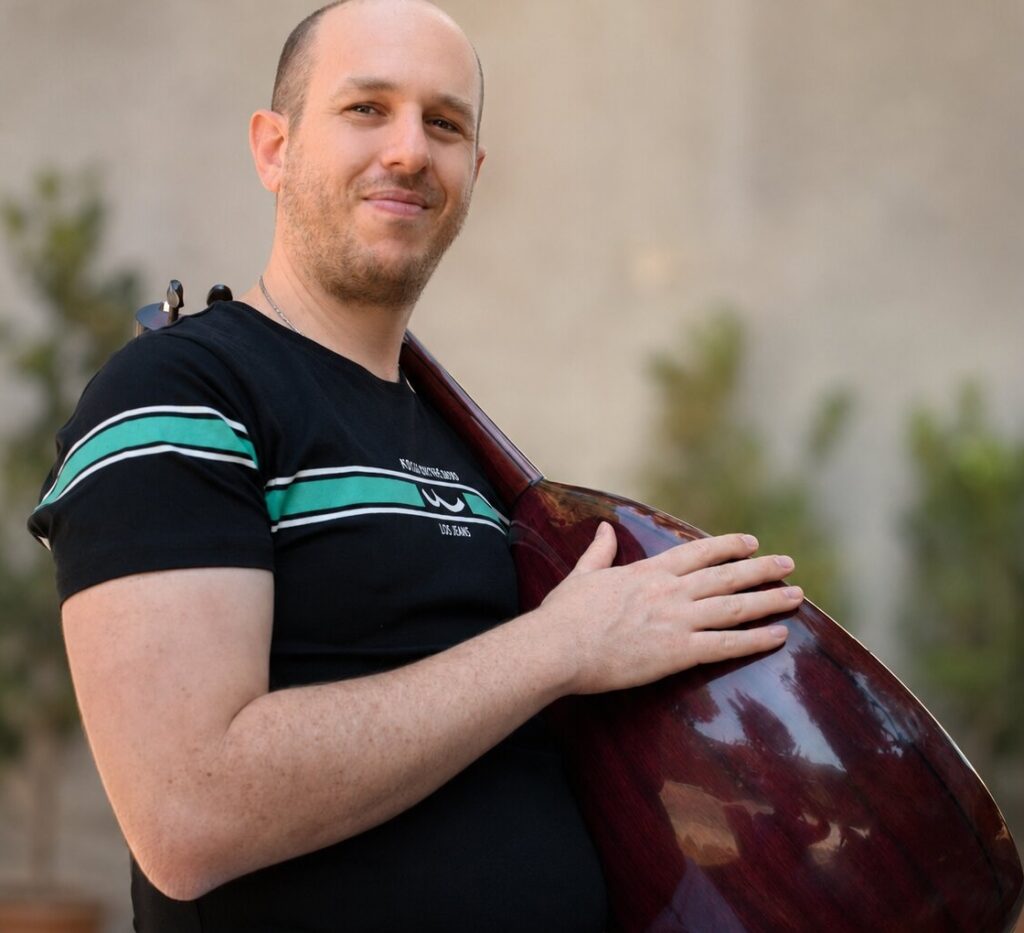
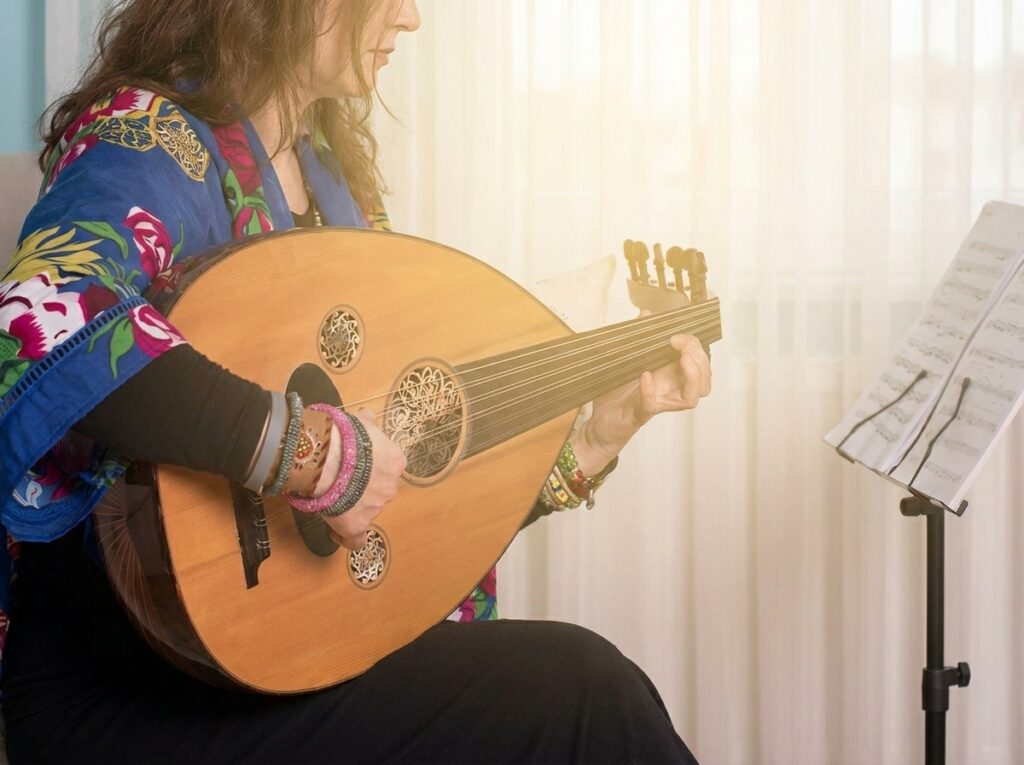
When an oud comes across my bench, I am not thinking about who will play it. I am thinking about the neck, the action, the string height, whether the pegs will hold. But ask most people to picture an oud player, and they picture a man. A man in a chair, eyes half closed, a long slow taqsim. Somewhere along the way the oud became, in people’s heads, a man’s instrument.
It was not always so, and this is the part worth saying out loud. Women have played the oud for a very long time. The old Arabic sources, al-Isfahani’s Book of Songs among them, already name women as accomplished players, and the stories of medieval Baghdad are full of women playing the oud at court. In the Ottoman world of the eighteenth and nineteenth centuries the oud was close to a woman’s instrument at home, and a young woman’s playing was counted as part of her worth. In early twentieth-century Istanbul, Mary Goshtigian, an Armenian, made her name in public as an oud player and singer. The oud is not one country’s instrument anyway. It lives in the Turkish, Arabic, Armenian and other traditions, and it does not sound the same in any two of them.
So the picture in our heads is actually quite new. It comes from the middle of the last century, when the oud went up onto the concert stage as a solo instrument, with Şerif Muhiddin Targan, then Munir Bashir, then Farid al-Atrash on the radio and in the films. The players who became famous were men, and after enough years, famous started to feel like the whole story. If you want the long version I once wrote out the great players who shaped the oud, and almost every name on that list is a man. That is the gap I want to fill here. Because the women are not a footnote to that story. They are playing at the very top of it right now.
The women playing it now
Rihab Azar grew up in Homs, in a musical family. Her father is a luthier, he built her first oud and taught her from the age of seven. She trained at the Damascus Conservatory under a line of oud masters, players like Askar Ali Akbar and Issam Rafea, and in 2014 she became the first woman to play the oud with the Syrian National Orchestra for Arabic Music. She co-founded a women’s ensemble in Syria, the Syrian Female Oriental Takht, and she now lives in London. What I like is that her training runs through Arabic, Turkish, Azerbaijani and Western classical music all at once, and you can hear all of it in her own compositions. Arts Council England picked her out as an artist of exceptional promise, she was a finalist for the Aga Khan Music Awards in 2025, and she teaches as well, running workshops at Oxford and Cambridge on who really owns this music. Her album Dandelion came out this year. Reviewers called it tender and haunting, and that is fair.
Kamilya Jubran is Palestinian, born in Acre in 1962. Her father taught music and made ouds, so like Rihab she started at home. For two decades she was the voice of the group Sabreen in East Jerusalem, a band that stood for the Palestinian voice through hard years, and those years showed her rare command of maqam. Here is the thing to understand about how she plays: the oud has no frets. There is nothing under the string telling your finger where the note is. So a player like Kamilya can bend a melody into the small spaces between the notes, the pitches a piano can never reach, and she does it with her voice and her oud together. Later she moved to Europe, worked with the Swiss musician Werner Hasler, and stripped it all back, voice and oud and qanun with only sparse electronics around them. She kept looking for her own sound and she found it. These days she also runs a nonprofit she started, Zamkana, and gives composition masterclasses to young Arab musicians, so what she learned does not stop with her.
Waed Bouhassoun comes from a Druze village near As-Suwayda in southern Syria, and she also picked up the oud at seven from her father. She sings in a low contralto, a dark and heavy voice for a woman, and she answers her own singing on the oud. Her repertoire is the mystical stuff, old devotional poetry and the modern poet Adonis, and on stage it goes quiet and inward rather than showy. By high school she was already winning regional competitions, and by eighteen she had performed across Syria. She is also an ethnomusicologist with a doctorate from Paris, she performs in Jordi Savall’s Orpheus XXI project with refugee musicians, and France made her a chevalier of arts and letters in 2018. Her latest project puts her on a stage full of other women who are, like her, both scholars and performers. Scholar and player in one person, which changes how carefully she treats a song.
And it is not only players who came up through the old cities. Aliya Cycon is American. She picked up the oud at eighteen while travelling in the Middle East, and four years later she became the first woman oud player to graduate from Berklee. She sings over her own oud in Arabic, Spanish and English, and she mixes it with jazz and flamenco, which should not work and does. She has played at the Nobel ceremony in Oslo and toured as a cultural ambassador, and now she teaches the oud online to a new crowd of players who found the instrument from outside, the way she did. She is proof that this instrument does not belong to one place or one gender any more, if it ever really did.
Why so few, and why that is changing
I see the change from behind the counter, and it is real. More women order ouds now than when I started in 2009. And they often order a particular thing. Many ask for a zenne oud, a Turkish oud built for women, a little smaller in the body, or a three-quarter size. A full Turkish oud has a long scale, close to 58 centimetres of string, the reach is real, and a smaller instrument sits easier under the hand. Ten years ago I was making very few of those. Now it is a normal order, and every one of them is a woman who has decided to play.
The younger generation is doing it differently again. Evy, a Lebanese singer and oud player based in Qatar, is one of many building an audience straight from her phone, posting her performances and reaching people who will never walk past a music school. If you want to see how many there are, search #femaleoudplayer on Instagram. It is a growing feed, a teenager filming a first taqsim in her bedroom right next to a touring professional, and it barely existed a few years ago. That matters more than it looks. A girl who wants to play can now watch a hundred women doing it before she ever has to walk into a room full of men.
So the honest answer to “why so few” is that there were never so few. Women always played, at home, in the ensemble, in the conservatory. Even once the oud became a man’s instrument on the concert stage, they kept playing it in the family room, where nobody was recording it, so it left almost no trace. What was missing was never the ability. It was the stage, the recording, the booking, the name on the poster. That is visibility, and visibility is exactly what is changing. More women are coming through the conservatories. More are teaching and playing online. And organisations like The F-List exist so that the people booking the festivals and the concert halls have no excuse left. That is most of what was ever missing.
Look at what the women at the top now do with their time. Kamilya gives composition masterclasses to young Arab musicians, Rihab runs her workshops at Oxford and Cambridge, Aliya teaches the oud online, Waed shares her stage with other women scholars. Every one of them is holding the door open behind her, and that is how a shift like this actually happens, one player passing it to the next.
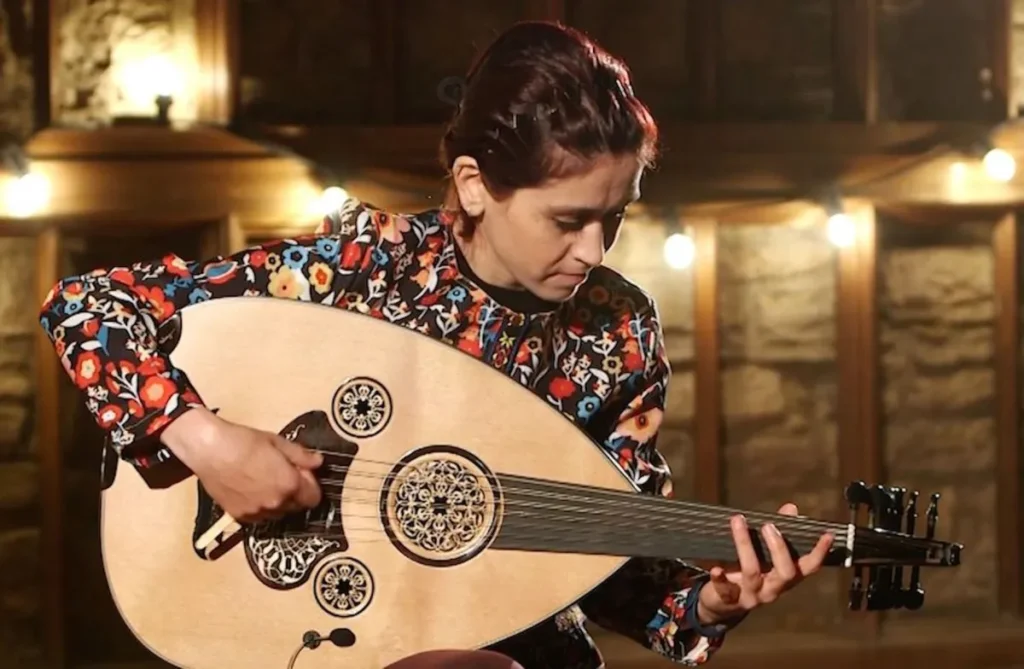
This month, in one building
You can watch both halves of this happen on the same day. On Saturday 18 July 2026, at Kings Place in London, Vick Bain, who runs The F-List, gives a lecture in the morning on women’s careers in music and why the numbers still look the way they do. That same evening, on the same stage, the Syrian oud player Rihab Azar plays a concert.
The morning is Vick explaining why the room was empty for so long. The evening is Rihab Azar, on the same stage, filling it. If you can be there, go, and listen to how she plays. Women have always played the oud. What has changed is that now you get to hear them.